

Appearance
ETF vs. Active Portfolio: How Passive and Active Investing Actually Work
When someone decides to enter the stock market, they immediately face the ultimate crossroads: should you buy a pre-packaged "bundle" like an index ETF (e.g., the S&P 500), or should you build your own portfolio from individual stocks?
Many believe that an ETF is a safe "set it and forget it" strategy, while active management is just risky "gambling." The reality is much deeper. The true difference lies in how capital is allocated, how rebalancing works, and who pays for the mistakes. Let’s break down exactly how both systems operate.
What is an S&P 500 ETF: The "Autopilot" Strategy
When you buy an ETF (Exchange Traded Fund), you are buying a tiny slice of a massive, pre-built portfolio. If it is an S&P 500 index fund, you instantly own a fraction of the 500 largest publicly traded companies in the US.
How it works: You make zero decisions. An algorithm dictates everything based on Market Capitalization. If a company's stock price surges and it becomes a giant, its weight inside the index increases. If a company degrades and its value plummets, the index eventually kicks it out and replaces it with a new leader.
The Pros of the Passive Approach:
- Instant Diversification: With a single purchase, you deploy capital across every sector of the economy.
- Low Barrier to Entry: You don't need millions of dollars to own a piece of 500 different businesses.
- No Human Error: It completely bypasses the 5 psychological traps of investing. There are no emotional decisions—just cold, automated tracking.
🚨 The Hidden Flaw: Buying the Garbage with the Gems
Because an ETF buys everything based on size, you are forced to buy the bad along with the good. In the S&P 500, there are incredible, cash-generating fortresses. But there are also "zombie companies" in a terminal decline, drowning in debt. In a passive ETF, you hold them both until they officially leave the index. By definition, you are locking yourself into an "average" result.
Active Investing: Building Your Own Engine
Active investing is when you (or the quantitative algorithms you use) select which specific stocks deserve your capital. You do not copy the market; you filter it.
The fundamental difference: In an ETF, stock weights are distributed by size. In a properly engineered active portfolio, weights are distributed by quality.
- You can decide that the technology sector is currently overheated and increase your allocation to defensive companies.
- You can actively exclude companies with dangerous Debt-to-Equity ratios that are still sitting in the S&P 500, dragging its overall yield down. (Learn how to spot these in our guide to reading financial statements).
Rebalancing: The Secret Engine of Compound Returns
Rebalancing is the process of returning your portfolio to your target target proportions. This is where the most fascinating difference between ETFs and active portfolios lies.
1. ETF Rebalancing (Mechanical & Flawed)
Inside an index, rebalancing happens automatically. But there is a massive catch: because it is market-cap weighted, the index naturally buys more of what has already gone up, and sells off what has already gone down. It is a mechanical process that systematically forces the fund to buy high and sell low during extreme market cycles.
2. Active Rebalancing (Conscious)
When you manage your own portfolio systematically, you use market volatility to your advantage.
- If a high-growth stock surges and suddenly occupies 20% of your portfolio instead of its target 10%, you lock in part of the profit (sell high).
- You take that cash and deploy it into high-quality assets that have temporarily dipped in price (buy low).
The Result: Over a 10-to-15-year horizon, this strict discipline of rebalancing adds an estimated 2-4% of annual excess return, which eventually compounds into a massive difference in total wealth.
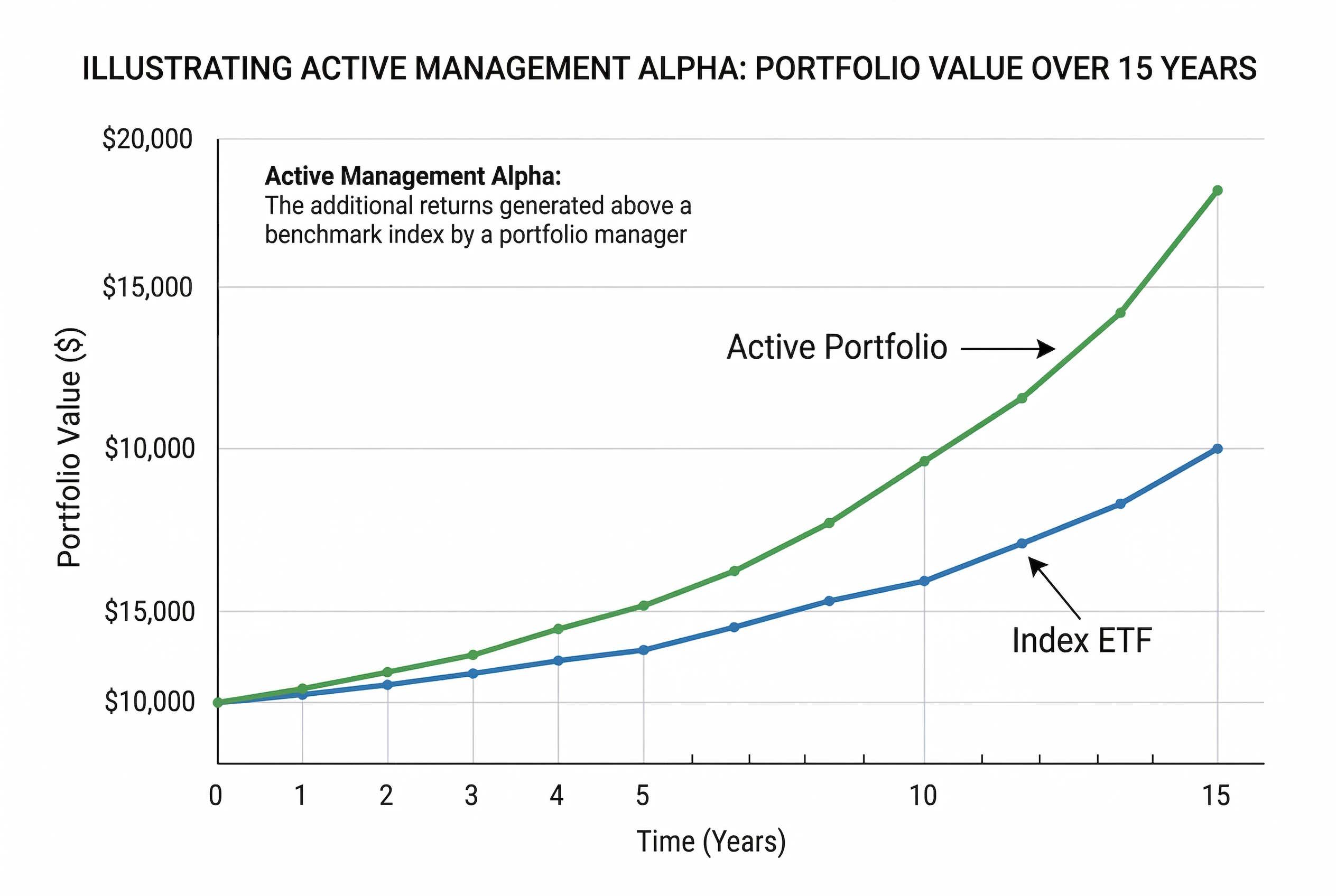 (The compound effect of active rebalancing over a 15-year horizon)
Comparison: Which Should You Choose?
| Feature | S&P 500 ETF (Passive) | Active Portfolio (Individual) |
|---|---|---|
| Time for Analysis | Near zero | Requires regular review |
| Fees | Low (Built-in to the fund) | Brokerage execution fees only |
| Risk Control | Market average | Complete (You decide how much risk to take) |
| Yield Potential | Strictly matches the market | Potential to outperform a broad index through active selection |
| Taxes | Paid upon selling the ETF | Can be optimized by selling individual positions |
(Note: Visualizing a chart comparing passive index growth versus an actively managed, quality-filtered portfolio is the best way to see this difference in action).
How TickerForge Changes the Game
In the past, active investing was only accessible to those willing to sit and read financial reports 24/7. That is why the majority chose ETFs—it was simply more convenient.
Today, technology allows you to take the best of both worlds. TickerForge gives you the elite performance of active management with the simplicity of a passive approach.
- Build a Custom Index: The program analyzes thousands of stocks and helps you build your own "index" consisting only of financially healthy companies. You throw out the garbage that drags the S&P 500 down.
- Smart Rebalancing: Instead of manually calculating asset weights in Excel, TickerForge's Portfolio Health Check gives you clear signals: what has grown too much and what is time to buy.
- Beta Control: You cannot regulate volatility in an ETF. In TickerForge, you set your comfort level, and the Stress Test algorithm ensures your portfolio won't shake violently during a market crash.
The Bottom Line
If your only goal is to protect your money from inflation and you refuse to look at the details, a broad-market ETF is an honest and reliable tool.
But if you want to build capital that works more efficiently than the market, and you are ready to dedicate a minimum amount of time using the right tools—choose the active approach.
Modern investing is no longer a choice between a "lazy" ETF and "complex" trading. It is a choice for systematic wealth building. By using tools like TickerForge, you turn your portfolio into a living mechanism that cleans out weak links and recharges with strong ones on time.
Related / Read Next
- Build a rules-based portfolio — see how an active model can apply quality and diversification constraints.
- How to choose assets for a long-term portfolio — compare selection discipline with broad passive exposure.
- The illusion of diversification — understand why an active portfolio can remain highly correlated.
- Portfolio diagnostics demo — compare public model portfolios across health, sector, and stress reports.
- Analyze your own portfolio — review whether your current structure behaves more like a broad index or a concentrated active bet.
Are you ready to stop settling for average market returns? Launch TickerForge in Telegram and start engineering your own institutional-grade portfolio today.